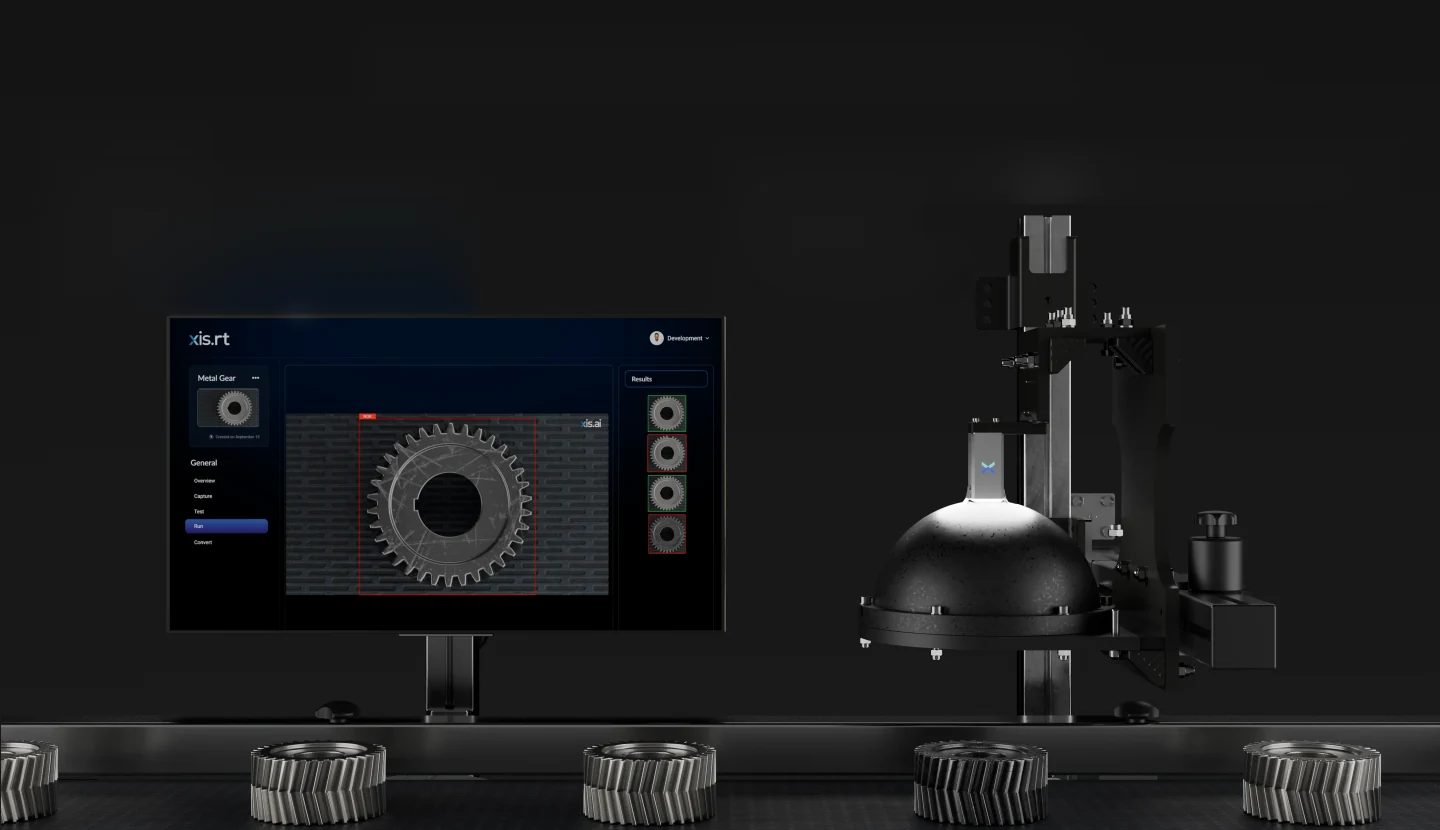
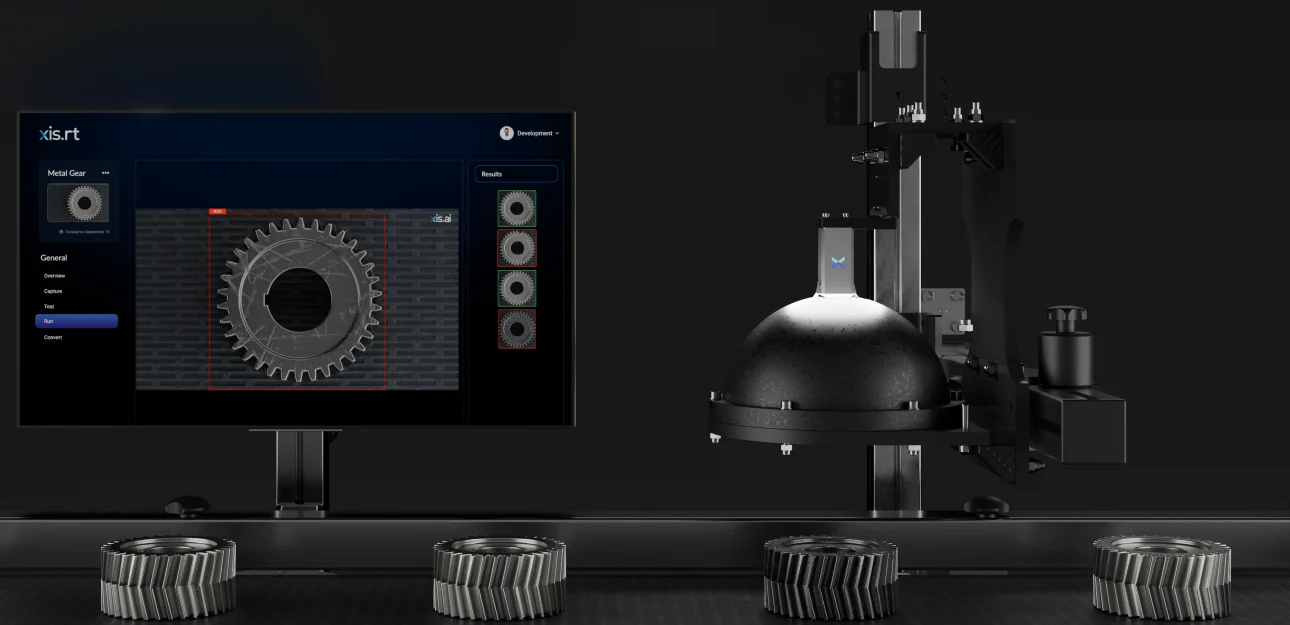
Edge AI visual inspection for consumer goods and bakery lines — trained by your team, running on an edge device at your line, logging a measurement for everything that passes the camera.
Standard industrial cameras and interfaces — nothing proprietary or vendor-specific.
02
Controlled lighting
Specified as part of the design. Illumination is where most vision systems fail on a live line.
03
An industrial PC with an NVIDIA GPU
Sited at the line, running xis.rt locally.
If you already have industrial cameras, lighting or an industrial PC on the line, they are not wasted — in most cases xis.ai retrofits onto the equipment you have.
The platform
Build the model. Run it at the line. See it across every site.
Three components covering the full inspection lifecycle — model development, real-time execution and multi-site analysis.
Build
xis.dev
Model development
Operated by your quality or process engineering team. Models are built around your defect classes, your tolerances and the conditions on your line — not adapted from a generic template. Examples are annotated without code and validated against held-back images before deployment, and when the product or specification changes, your team retrains it directly.
Configured to your defect classes and tolerances.
No-code annotation and training.
Retraining in-house on product change.
Run
xis.rt
Line runtime
Deployed on an edge device at each inspection point. Runs state-of-the-art AI models at 150 frames per second and integrates directly with your PLC and MES over OPC-UA and MQTT, signalling reject, alarm or line halt and recording a result for every unit inspected. Runs independently of every other component, with no cloud service and no internet connection required.
State-of-the-art models at 150 fps
PLC and MES integration over OPC-UA and MQTT
Operates standalone, fully offline
Analyse
xis.dashboard
Multi-site analysis
Every xis.rt instance reports into a single dashboard, consolidating results, images and metadata across lines, plants and countries. Deployed on your own servers, giving quality and operations management comparable performance data from every site without any of it passing through a vendor cloud.
Trends and actionable insight across lines and shifts
Comparable performance between plants and countries
Hosted on your infrastructure, not ours
xis.dev
Model development Your engineering team.
Models
Plant A
Line 1 · xis.rt
Camera + lighting + industrial PC
Line 2 · xis.rt
Camera + lighting + industrial PC
Plant B · another country
Line 1 · xis.rt
Camera + lighting + industrial PC
Line 2 · xis.rt
Camera + lighting + industrial PC
Results
xis.dashboard
One view, every site On your servers.
Models are built once and deployed to every inspection point. Each line runs its own xis.rt independently, and every instance reports results, images and metadata into a single dashboard — across lines, plants and countries.
What it runs on
Three components per inspection point.
01
An industrial camera
Standard industrial cameras and interfaces — nothing proprietary or vendor-specific.
02
Controlled lighting
Specified as part of the design. Illumination is where most vision systems fail on a live line.
03
An industrial PC with an NVIDIA GPU
Sited at the line, running xis.rt locally.
Models are built once and deployed to every inspection point. Each line runs its own xis.rt independently, and every instance reports results, images and metadata into a single dashboard — across lines, plants and countries.
Applications
What it checks
Is this unit damaged?
Defect detection
Finds cracks, scratches, dents, burns, contamination and discolouration on the product or its packaging.
Does this unit look wrong, somehow?
Anomaly detection
Learns what acceptable product looks like and flags anything that deviates — including faults you have never seen before and could not have collected examples of.
Is the right label on, and readable?
Label verification
Confirms the correct label for the product, applied straight and in the right place, undamaged and legible.
Is the date and batch code right?
Code & text reading
Reads printed date codes, lot numbers and batch marks, and checks each one against what should be on that pack.
Will this pack reach the customer intact?
Seal & packaging
Checks seal integrity, fill level, closure and overall pack condition before the unit leaves the line.
Is it the right size and shape?
Measurement
Records height, width, diameter and form as an actual value for every unit — so you can see a line drifting, not just units failing.
Is everything there, in the right place?
Object detection
Checks that caps, seals, components, inserts or leaflets are present, correctly positioned and the right number of them.
Which type is this one?
Classification
Sorts units by grade, variant or product type at line speed, so each goes where it should.
Industries
Two we know deeply. more we work in.
Consumer goods
Fast lines, printed packaging and tight changeovers. Label, code, fill and seal verification where a mistake becomes a return.
[Pricing model — licence, per line, per camera. What's included, what's separate, and whether hardware and integration are line items.]
Who integrates it
[Your team, a partner, or theirs. What you deliver, where your responsibility ends, what the customer provides.]
What support looks like
[Response times, who answers, what's covered, and what happens when a line is down out of hours.]
Hardware independence
An industrial camera, controlled lighting and an industrial PC with an NVIDIA GPU at each inspection point. Standard interfaces throughout, no closed hardware ecosystem, and existing equipment on the line can usually be retrofitted.
What gets recorded
Every unit logged with its measured value and image reference. Repeatable inspection records for traceability and audit, exportable to [formats].
Where your data lives
On an edge device in your facility. No cloud dependency, no internet required, no images leaving your network.
Getting started
Four steps, and you can stop after any of them.
01
Feasibility check
Send images of the defect that matters. We train a model and tell you honestly whether it works — including when it doesn't. No cost, no commitment.
[~1 week]
02
Trial
We test against your real conditions — line speed, lighting, and how much your product actually varies day to day.
[Your figure]
03
Pilot
One line, running live alongside your current process so you can compare the two directly.
[Your figure]
04
Production
Integration with your line, training for your team, and the dashboard once you add a second line.
[Your figure]
Next Step
Find out if it works on Your Problem
Start Here
Send us 20 images
Share images of the defect you care about. We train a model and send back an honest feasibility assessment — including whether it won't work.