
No two units are alike.
It still has to be right.
AI inspection for bakery and food production — built for product that varies by nature, on lines that get washed down every day.
Test it on your productThe Hard Case
A fixed tolerance assumes
the product repeats. Dough doesn't.
Rule-based vision measures against a known target, which works on a stamped part. On a proofed dough, a hand-topped roll or a naturally variable bake it falls apart — every unit legitimately differs, and the acceptable range is wide but not unlimited.
Set the tolerancetight and you reject good product.
Loose and you passgenuine faults.
Neither is an inspection system;both are a cost.
xis.ai learns the shape of normal for your product from your own line, then flags what sits outside it. That is a different problem from checking a dimension against a number, and it is the reason food lines are where rule-based systems are abandoned most often.
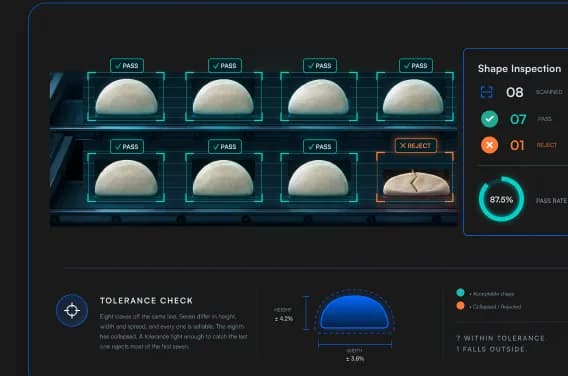
Volume and shape are separate properties.
German cereal-science method keeps height-to-width ratio as its own measurement because it correlates with volume at only about 0.42. A loaf can hit its volume target and still be the wrong shape.
Appearance is scored, not just noticed.
Bread assessment schemes and retail specifications grade form and appearance alongside crumb, crust and taste. Shape is a specification attribute, and it is usually the first one a buyer applies.
What it checks
The checks a bakery line
actually needs.
Is it baked to the right shade?
Bake colour
Grades browning across the whole surface rather than at one spot, and catches drift before a batch goes pale or dark enough for anyone to notice by eye.
Is it the right shape for this product?
Shape & form
Height, width, proportion and outline — recorded as values, so you see a proofing or divider problem as a trend rather than as scrap.
Is there anything in it that shouldn't be?
Foreign body
Detects visible contamination on the product or in the pack before it leaves the line.
Is the topping there and even?
Topping & seeding
Presence, coverage and distribution of seeds, glaze, sugar or garnish — the checks that are easy for a person to wave through at speed.
Is that a scoring cut or a break?
Cut, score & split
Distinguishes intentional scoring from cracking and tearing, which fixed-rule systems consistently confuse.
Is the tray right?
Count & placement
Counts units per tray or pack and checks position and spacing before sealing or freezing.
Will the pack hold?
Seal & packaging
Seal integrity, product trapped in the seal, closure and pack condition.
Right label, readable code?
Label & date code
Correct label for the product, applied straight and legible, with date and lot codes read and checked against what should be on that pack.
What does the bottom look like?
Underside
Base bake, burn and sticking, using a second inspection point where the underside matters.
Built for the environment
Flour, steam, heat and a
washdown every night.
A bakery is one of the harder places to keep a vision system working. These are the conditions the hardware is specified against, not an afterthought.
ENVIRONMENT
Built for stability. Designed for real-world conditions.
- Ingress protectionIP69K housings for high-pressure, high-temperature washdown
- MountingEHEDG-style drainable mounting, no flat surfaces holding water
- MaterialsWashdown-compatible, cleaning-chemical resistant
- Heat and steamSited and shielded for oven-side placement
- Airborne flourSealed optics with a cleaning interval defined during the trial

IMAGING
Clearer vision. Smarter inspection.
- Colour and shapeRGB industrial cameras
- Volume and height3D sensing where form matters beyond the outline
- Browning and moistureNIR where bake state is not reliably visible in colour alone
- Continuous webLine-scan for sheeted and continuous product
- UndersidesMultiple inspection points with reorientation
- LightingDome, backlight or structured, specified per application
On lighting. Ambient-light dependence is the most common reason food vision systems fail after installation — a system commissioned in winter behaves differently in July with the doors open. Illumination is specified and validated as part of the design, not fitted around a camera afterwards.
Where shape is a specification
In parts of this industry,
form is not cosmetic.
For most bakery product, appearance is a commercial standard. For some, it is a legal one — and the criteria are written in words a camera can check but a caliper cannot.
Registered designations
Geographical-indication schemes operate in most major markets. A registered product carries binding physical specifications — dimensions, weight and permitted shape — and product outside them may not carry the protected name.
Criteria written as description
Both registered specifications and retail standards often describe form in words rather than numbers — an even external form, a correct crust break, a characteristic profile. These are criteria a vision system can encode and a measuring tool cannot.
Shape as identity
In some markets shape is protected in its own right, and presenting a product in a form confusable with a protected one is itself actionable. Where that applies, shape stops being decoration and becomes identity.
The platform
Same three components,
tuned to your product.



Partner tracks
The obligations
behind the inspection.
The published criteria your customers, auditors and quality team already reference. We train models against your interpretation of these standards — we do not certify conformance to them, and an inspection result is not a conformity assessment.
Reg (EU) 1169/2011
What it covers
Food information to consumers. Requires the label to be easily visible, clearly legible and indelible, with allergen and ingredient declaration and date marking.
Where it applies
Label verification, print legibility and date coding
Reg (EU) 178/2002
What it covers
General food law. Establishes one-up, one-down traceability for food business operators.
Where it applies
Lot code verification and the per-unit record
Directive 76/211/EEC
What it covers
Making-up by weight or volume of certain prepackaged products. Sets the average quantity rules enforced nationally.
Where it applies
Fill level and net quantity
GFSI schemes (BRCGS, IFS)
What it covers
Certification scheme requirements including start-of-run, interval and end-of-run verification with equipment self-test.
Where it applies
Scheme evidence produced automatically from inspection logs
Bakery questions
What bakers ask first.
By learning the range rather than a target. The model is trained on your own production, so it knows how much variation is normal for your product and flags only what falls outside it. This is the opposite of a fixed tolerance, and it is why it works where rule-based systems do not.
Still deciding
The one question this page can't answer:
does it work on your defect?
Start here
Send us your images
Share examples of the defect you care about. We train a model on your product and come back with a straight answer — including if it's no.
Start a feasibility checkOr ask directly
Talk to an engineer
Thirty minutes with someone who builds this. Bring your line speed, your defects and your integration constraints.
Get a demo