Quality

Runs at the line on an industrial PC, at 150 fps, signalling your PLC over OPC-UA or MQTT.

AI inspection for consumer goods production — where the line runs fast, the variants change constantly, and a labelling mistake becomes a return.
Test it on your productThe Hard Case
Consumer goods lines mostly do not fail on the product itself. They fail on the pack: the wrong label for the variant, a date code that smeared, a seal that caught product, a case short by one.
These are verification problems rather than judgement problems, which makes them well suited to a camera and badly suited to a person watching several hundred packs a minute.
The difficulty is changeover. A line running six variants in a shift needs the inspection to change with it — and a system that has to be reconfigured at every switch will quietly be turned off by the second week.
Different products running on the same line, each with its own checks, without reconfiguring the system between runs.
It is the recall, the retailer relationship and the retrospective check on everything shipped since the error started — which is why the per-unit record matters as much as the detection.
What it checks
Right label, right variant?
Confirms the correct label for the product running, applied straight and in the right position, undamaged and legible.
Is the code there and readable?
Reads printed date and lot codes and checks each against what should be on that pack, catching smears, drop-outs and misprints.
Is the pack filled correctly?
Checks fill height or level against the specification for that variant, recorded as a value for every unit.
Will the pack hold?
Seal condition, product trapped in the seal, closure seating and cap presence before the pack leaves the line.
Is the print legible and complete?
Detects missing, faint or misaligned print on packaging and sleeves, including partial printhead failures.
Is the case right?
Counts units per case or tray and checks orientation and position before closing.
Is it on straight and tight?
Cap presence, cross-threading, tilt and colour against the variant specification.
Does the pack look sellable?
Dents, scuffs, creases and contamination on the pack face that a retailer would reject.
Is this the product we think it is?
Confirms the product running matches the job, which is where changeover errors are caught before a pallet is built.
Built for the environment
Consumer goods lines are less hostile than a bakery but less forgiving on speed. These are the conditions the hardware is specified against.
Built for stability. Designed for real-world conditions.
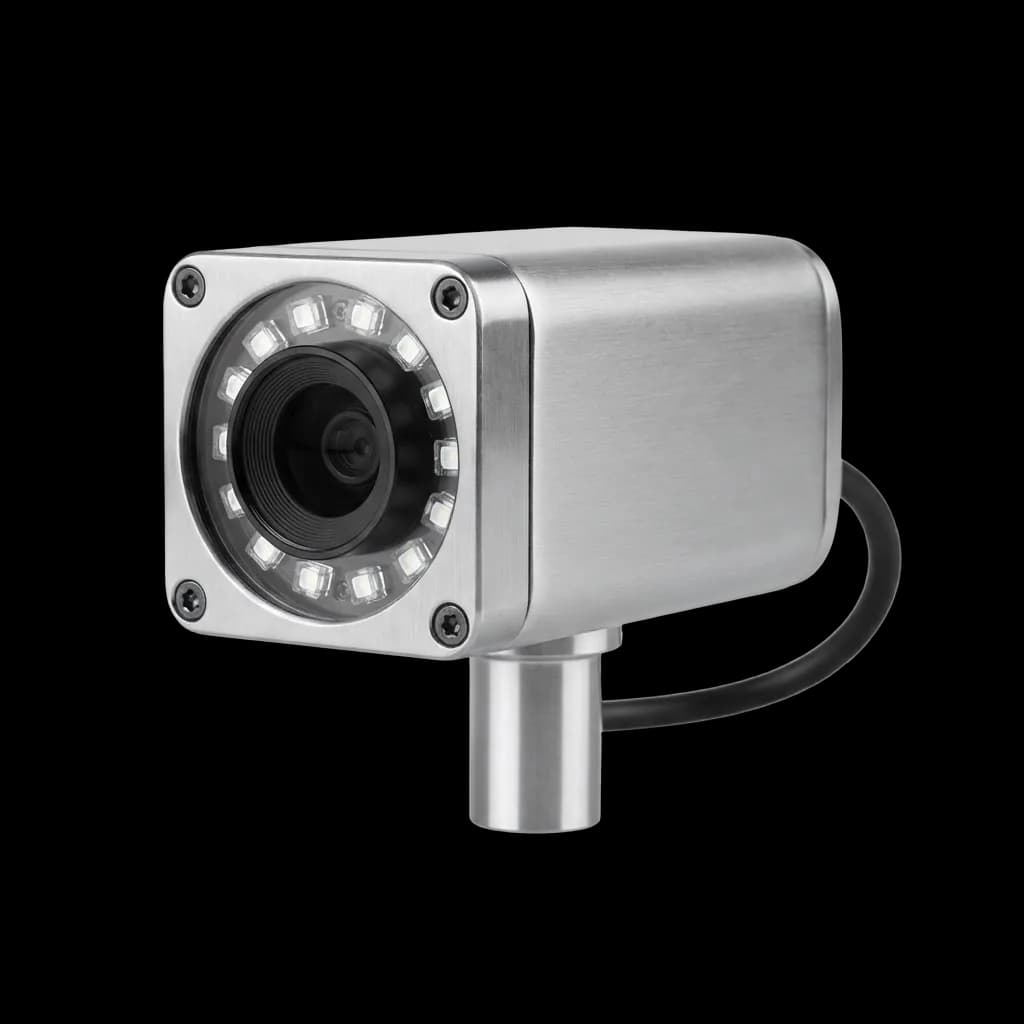
Clearer vision. Smarter inspection.
On lighting. Printed and filmic packaging is reflective, and reflective surfaces are where lighting geometry decides whether a system works at all. Dome, backlight or structured illumination is specified per application and validated on your material, not assumed from the camera.
Where the record matters
Labelling, date coding and net quantity are not quality preferences in the EU — they are legal requirements, and your certification scheme adds verification duties on top.
Label legibility, date and lot code presence and one-up one-down traceability are required by EU food information and food law. Inspection is how you meet them at line speed.
Average quantity rules under the EU prepackaging directive, enforced nationally, make fill control a legal as well as a commercial matter.
GFSI-recognised schemes such as BRCGS require start-of-run, interval and end-of-run verification with equipment self-test. A system that logs every unit produces that evidence automatically.
The platform
Partner tracks
The published criteria your customers, auditors and quality team already reference. We train models against your interpretation of these standards — we do not certify conformance to them, and an inspection result is not a conformity assessment.
What it covers
Food information to consumers. Requires the label to be easily visible, clearly legible and indelible, with allergen and ingredient declaration and date marking.
Where it applies
Label verification, print legibility and date coding
What it covers
General food law. Establishes one-up, one-down traceability for food business operators.
Where it applies
Lot code verification and the per-unit record
What it covers
Making-up by weight or volume of certain prepackaged products. Sets the average quantity rules enforced nationally.
Where it applies
Fill level and net quantity
What it covers
Certification scheme requirements including start-of-run, interval and end-of-run verification with equipment self-test.
Where it applies
Scheme evidence produced automatically from inspection logs
What it covers
Print quality grading for 1D and 2D codes, A to F. Applies wherever a code has to be read reliably by someone downstream.
Where it applies
Barcode and data matrix verification
Consumer goods questions
No. A single xis.rt instance handles several product variants at once, each with its own checks, so the inspection follows the job rather than needing to be switched with it. Adding a new variant is a task for your own team in xis.dev.
Still deciding
Start here
Share examples of the defect you care about. We train a model on your product and come back with a straight answer — including if it's no.
Start a feasibility checkOr ask directly
Thirty minutes with someone who builds this. Bring your line speed, your defects and your integration constraints.
Get a demo