
AI-Powered Tablet Inspection: Detecting Chips, Cracks, and Shape Defects

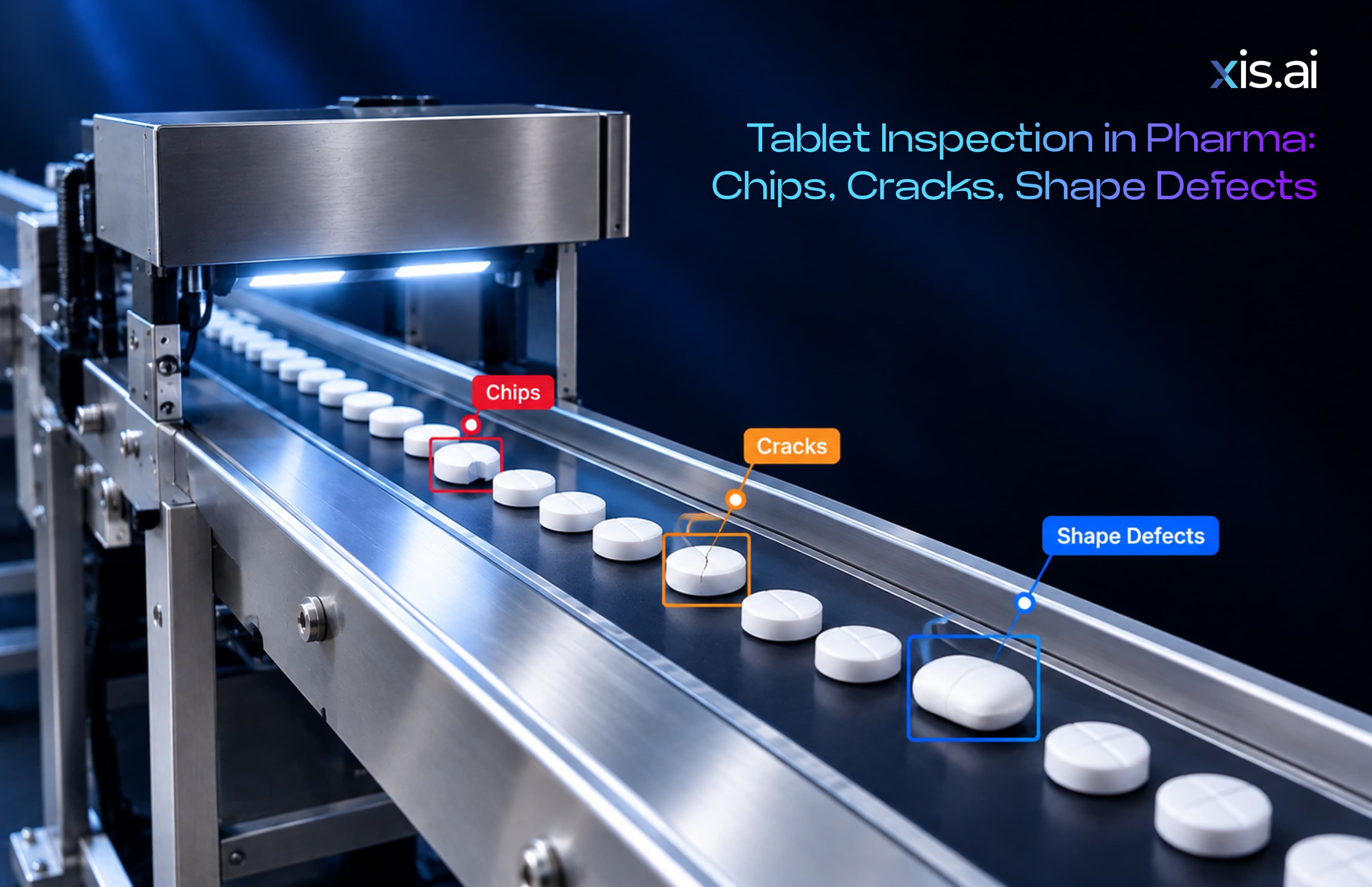
Tablet defects are not always easy to distinguish from normal product variation. A chipped edge may indicate damage during handling, a visible crack may compromise a tablet’s appearance, and an irregular outline may signal a problem with its shape. At the same time, natural differences in coating, color, and tablet geometry can make acceptable products appear defective.
For pharmaceutical manufacturers, the challenge is to identify visible defects consistently without rejecting acceptable tablets unnecessarily. AI-powered visual inspection offers a way to analyze tablet images against defined quality criteria, helping manufacturers detect specified surface and shape abnormalities during production.
The effectiveness of this approach depends on image quality, the defects being inspected, and how thoroughly the model is trained and validated for the intended application.
What Does a Tablet Inspection System Need to Detect?
The inspection criteria should reflect the tablet’s design and the defects that matter to product quality. Four common categories are particularly relevant to image-based inspection.
Chipped edges and broken tablets
Chipping can occur during tablet handling, transfer, or packaging. It may appear as a missing fragment, a notch along the edge, or an uneven outline. More extensive damage can leave a tablet visibly broken.
An AI model can be trained to distinguish these patterns from acceptable features, including intentionally scored edges and variations that fall within the product’s specifications.
Visible cracks
Cracks may appear as fine lines, surface splits, or more pronounced fractures. Their detectability depends on factors such as tablet color, surface finish, lighting, and camera resolution. Fine cracks can be particularly challenging when they have low contrast against the surrounding surface.
Reliable detection therefore requires representative images of the relevant crack types and validation under the intended inspection conditions.
Shape deviations
Tablets are manufactured in a variety of shapes, including round, oval, oblong, and custom geometries. Deformed outlines, uneven edges, or other departures from the intended shape may indicate a defect.
The inspection model must account for the specific tablet design. A feature that is abnormal for one product may be entirely acceptable for another.
Coating and surface irregularities
Visible coating damage, unusual discoloration, surface spots, and distinguishable foreign material may also warrant inspection. AI can identify defined visual patterns when they are sufficiently visible in the captured images and adequately represented in the model’s training and evaluation data.
Image-based inspection is limited to observable features. It cannot establish a tablet’s chemical composition, active ingredient concentration, dosage, or internal integrity from an ordinary surface image.
Manual Inspection, Optical Rules, or AI?
Different inspection methods offer different advantages, and the appropriate choice depends on the production requirements.
Manual visual inspection relies on an inspector’s judgment and experience. It can be useful for examining unusual cases, but inspection results may vary with viewing conditions, workload, and individual interpretation. Sampling also provides limited coverage when only a portion of production is examined.
Rule-based optical inspection uses predefined thresholds and measurements to assess image characteristics such as dimensions, shape, or color. This approach can work well when defects are clearly defined and inspection conditions are stable. However, complex surface variations may be difficult to capture through fixed rules alone.
AI-based visual inspection learns patterns from labeled examples of acceptable products and specified defects. This can help distinguish more complex visual differences, provided the training data reflects the variation encountered in production.
AI is not inherently more accurate than every conventional method. Its performance must be measured against the same acceptance criteria, using representative images and realistic operating conditions. Missed defects and false rejects both matter: a system that flags every unusual feature may create unnecessary waste, while one that overlooks defects may fail to meet quality requirements.
Developing and Deploying Tablet Inspection Models with xis.ai
xis.ai provides a computer vision platform for developing and deploying AI-based visual inspection models.
For tablet inspection, xis dev is the relevant capability for preparing labeled image data, training models, and evaluating their ability to recognize defined visible defects. This supports the development process for inspection tasks involving chipped edges, visible cracks, shape deviations, and coating irregularities.
The model’s suitability must be established through evaluation against representative images and the manufacturer’s acceptance criteria. Training a model does not, by itself, guarantee that every defect will be detected or that acceptable tablets will never be rejected.
Once a model has been developed and validated for its intended task, xis.rt can support its deployment into a suitable inspection workflow. Its role is to make the validated model available for operational use; the resulting performance still depends on the imaging setup, deployment conditions, and validation of the complete inspection process.
The same principles apply across other pharmaceutical packaging applications, although the inspection criteria differ. For example, vial inspection focuses on visible glass defects, while blister pack inspection addresses visible packaging and product-presentation issues.
Frequently Asked Questions
Can one model inspect different tablet shapes and coatings?
Not necessarily. Different designs and surface appearances can affect detection performance. Each relevant product variation should be evaluated, with additional training or adjustments where required.
Can visual inspection verify the dosage or chemical composition of a tablet?
No. Image-based AI inspection evaluates visible characteristics. Chemical composition and dosage require appropriate analytical or measurement methods.
Does AI eliminate the need for quality validation?
No. A model must be evaluated against defined acceptance criteria under representative conditions. Its performance should also be reassessed when relevant products, imaging conditions, or production requirements change.
Comment
0Comments
No comments yet.