
Fill Level Inspection: What Happens When the Fill Is Wrong?

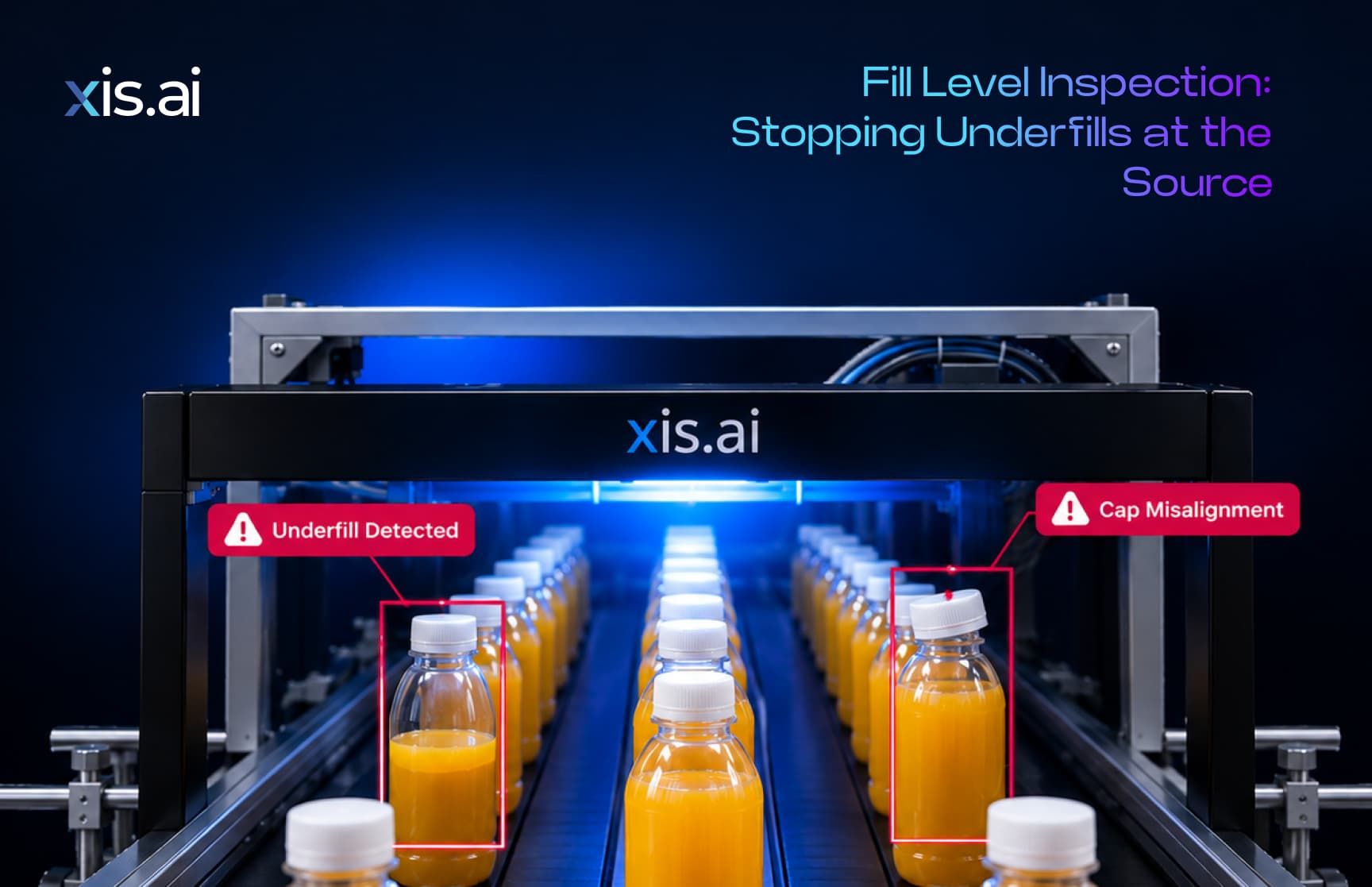
A filling machine can run smoothly, maintain its cycle time, and produce containers that look nearly identical. Yet some may contain less product than intended, while others receive more than the target quantity. Without an effective inspection process, these deviations can continue unnoticed until they appear in quality checks, customer complaints, or production records.
Underfilling and overfilling create different problems. An underfilled package may fail to meet its declared quantity requirements. Overfilling consumes additional product without necessarily increasing revenue. At high production volumes, even a small recurring deviation can become costly.
The challenge is identifying these deviations using a measurement method suited to the container and product. For transparent packaging, AI-powered visual inspection can help assess the visible liquid level. Where the contents cannot be seen, a different measurement approach may be necessary.
The Fill Line Is Only Useful If You Can See It
Consider a transparent beverage bottle moving through an inspection station. A camera captures the liquid boundary, and a computer vision model assesses its apparent position against the expected fill range. If the observed level falls outside the defined criteria, the container can be flagged for further action, depending on how the inspection system is integrated.
That process sounds straightforward until the packaging changes.
A curved bottle can distort the apparent liquid boundary. Reflections may obscure the fill line, while condensation or inconsistent lighting can make it harder to distinguish the liquid from the container. If the image does not show the relevant feature clearly, the model has insufficient visual evidence to assess it reliably.
This is why successful fill-level inspection depends on the complete imaging setup—not just the AI model. Camera position, lighting, image resolution, container movement, and the visibility of the liquid boundary all affect the result.
The same principle applies to different liquid products. Clear beverages may be suitable for visual assessment, whereas opaque dairy cartons or other packaging that conceals the contents may require weight-based verification or dedicated fill-level sensors.
AI cannot recover a liquid boundary that an ordinary camera image does not reveal.
When a Small Deviation Keeps Reappearing
An isolated fill-level deviation may require a check of the affected container. A recurring pattern deserves a closer look at the process.
If multiple containers repeatedly appear underfilled, the findings may justify investigating filling settings, equipment performance, or process variation. If overfilling occurs consistently, reviewing the target settings may help identify opportunities to reduce unnecessary product consumption.
Inspection data can help pinpoint where a problem occurs, but it does not establish the cause automatically. The actual cause must be investigated using appropriate production evidence.
This distinction matters because the cost of a fill-level problem is not limited to rejected containers. Underfilling can create customer dissatisfaction and potential compliance issues, depending on the product and applicable requirements. Overfilling can quietly increase material consumption across an entire production run.
For manufacturers, the objective is to identify deviations early and investigate recurring patterns before they become a larger quality or cost problem.
Height, Volume, and the Measurement Gap
One important technical distinction is often overlooked: liquid height is not the same as liquid volume.
In a container with straight, uniform sides, changes in liquid height may correspond predictably to changes in volume. In a bottle with a curved shoulder or a varying cross-section, the relationship is different. The same change in height can represent different changes in volume depending on the container's geometry.
A camera-based inspection system therefore needs an appropriate reference and validation process if its visual measurements are being used to assess fill quantity. The required accuracy determines whether image-based assessment is suitable or whether a complementary measurement method is needed.
Pharmaceutical applications require particular care. An incorrect fill quantity can affect product conformity, and the implications for delivered dose depend on the formulation, concentration, and delivery method. Visual fill-height inspection should not be treated as proof of exact volume or dosage without appropriate validation.
Product changeovers also require attention. Different bottle designs, liquid appearances, and target levels may require new configurations or additional validation. A model should not be assumed to adapt automatically to every new product simply because it operates on the same production line.
Where xis.ai Fits
xis.ai provides a computer vision platform for developing AI-based visual inspection models. In fill-level inspection, its relevant application is identifying visible liquid-level deviations when the container and its contents can be captured clearly enough for image analysis.
The platform supports the development and evaluation of models against defined visual criteria, helping establish whether the model is suitable for the intended inspection task. The model must be tested with representative images and production conditions before its results are used for quality decisions.
The value of AI visual inspection lies in applying consistent inspection criteria to suitable images. It does not remove the need for appropriate measurement methods where exact quantity verification is required, nor does it replace weight-based measurement when packaging prevents direct visual assessment.
Fill-level inspection can also form part of a broader packaging quality process. AI-powered bottle inspection addresses visible bottle defects, while AI cap inspection focuses on missing or visibly misaligned closures. These checks can complement one another, but each assesses a different quality characteristic.
Four Questions Worth Asking Before Implementation
Can ordinary camera inspection assess fill levels in opaque cartons?
Not when the liquid boundary cannot be seen. Weight-based verification, dedicated sensors, or another appropriate measurement method may be needed.
Does a correct-looking fill height prove the exact volume?
No. Container geometry affects the relationship between height and volume. Accurate quantity verification requires appropriate calibration and validation or a complementary measurement method.
Will the same model work with every container size?
Not automatically. Changes in container geometry, liquid appearance, and target fill level may require configuration changes, further training, and renewed validation.
Comment
0Comments
No comments yet.